
Our Service
Root Canal Treatment in Haripad, Alappuzha – Painless Tooth Saving Care
A tooth can look surprisingly normal while the tissue inside it is already badly inflamed or infected. There may be no obvious cavity when looking in the mirror. Sometimes there is not even continuous pain. The problem sits deeper, inside the pulp chamber and root canals, where the nerve tissue and blood vessels of the tooth are located.
This is where decisions become less straightforward than patients expect.
A toothache does not automatically mean a root canal. Sensitivity to cold may come from exposed dentine. Pain while chewing may be caused by a cracked filling, a high restoration, gum inflammation or even excessive biting pressure. A deep cavity may produce sensitivity without the pulp being irreversibly damaged.
The opposite also happens. A tooth that has stopped hurting can actually be in worse condition.
When the pulp dies, the intense nerve pain may disappear. A patient assumes the problem has settled. Weeks or months later, swelling develops around the root, a small pimple appears on the gum, or the tooth becomes tender when biting.
Good diagnosis comes before treatment.
A dentist may need to combine an examination with dental X-rays, cold testing, percussion, palpation, periodontal probing and an assessment of the existing restoration. No single test gives the entire answer.
For patients considering Root Canal Treatment in Haripad, the real question should not simply be, “Can the pain be stopped?” It should be, “Can this tooth be predictably restored and kept functioning?”
That distinction matters.
A root canal is worthwhile when the tooth has enough healthy structure remaining, the supporting bone and gums are reasonably stable and the tooth can be restored properly afterwards. There are cases where technically completing a root canal is possible but preserving the tooth still makes little sense. A vertical root fracture, severe decay extending far below the gum, advanced periodontal destruction or inadequate remaining tooth structure can change the recommendation completely.
Saving a natural tooth is usually preferable when the prognosis is sensible.
Saving a hopeless tooth at any cost is not.
What Root Canal Treatment Actually Does
Root canal treatment is not the removal of the tooth root.
That misunderstanding still causes unnecessary anxiety.
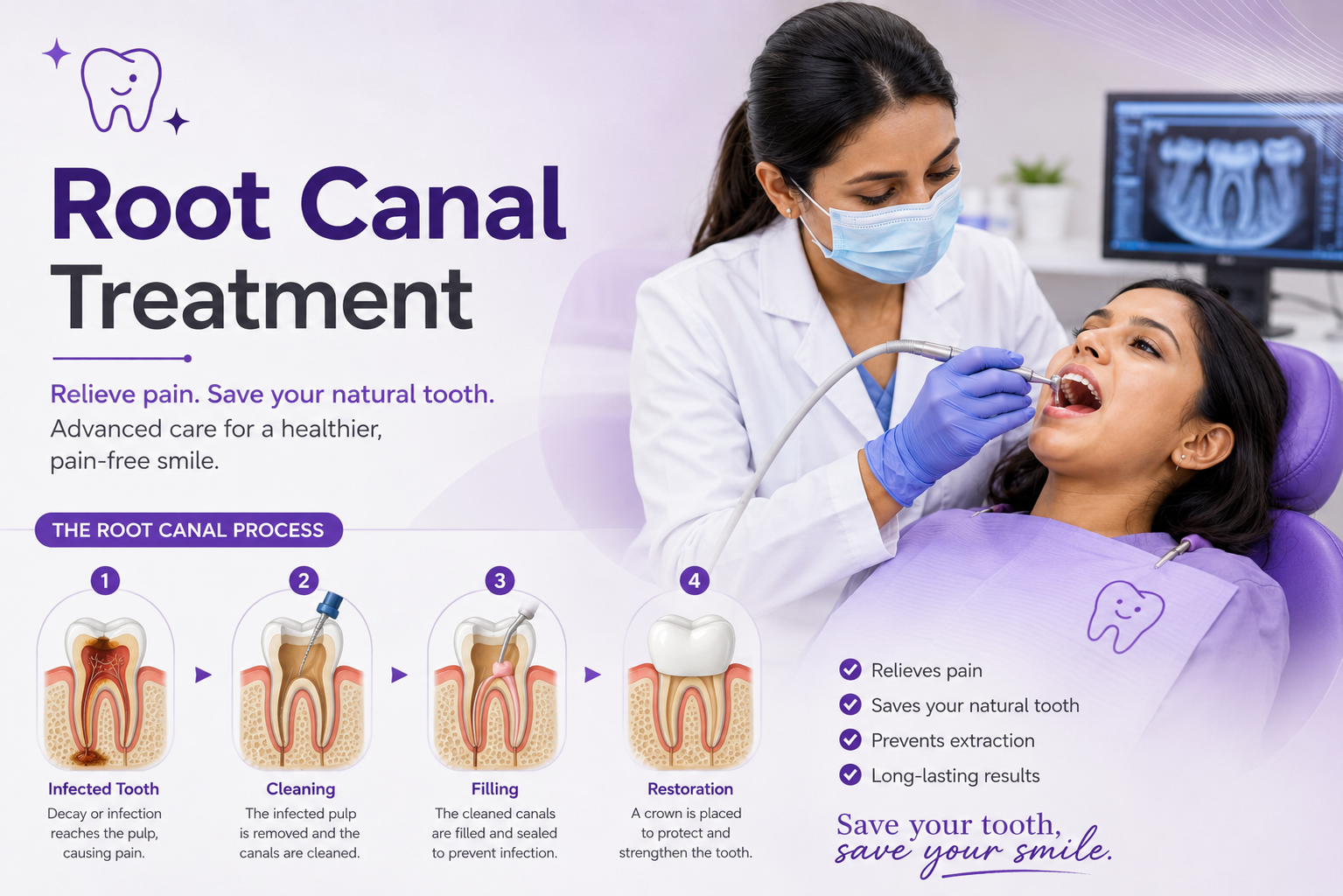
The tooth stays in place. The dentist removes inflamed, infected or dead pulp tissue from the spaces inside the tooth, disinfects those spaces and seals the root canal system. The purpose is to eliminate or control infection while keeping the outer structure of the natural tooth available for chewing.
Treatment normally begins with local anaesthesia.
Once the tooth is numb, an opening is made through the biting surface or existing restoration to reach the pulp chamber. A rubber dam is generally used to isolate the tooth from saliva. This small detail matters far more than patients realise. Root canal treatment involves careful disinfection inside a very small internal space; contamination from saliva works against that objective.
The canals are then identified.
That may sound simple until the anatomy is considered. A front tooth may have a relatively straightforward canal system. Molars can contain several canals, narrow branches, curves, calcified sections and anatomical variations. Missed anatomy is one reason apparently completed root canals occasionally remain symptomatic.
Fine instruments are used to clean and shape the canals. Irrigating solutions help disinfect areas that instruments cannot physically touch. Working length has to be controlled carefully so cleaning reaches sufficiently close to the root end without unnecessary irritation beyond it.
After preparation and disinfection, the canals are sealed with a root-filling material.
The job is still not finished.
What happens above the root canal can be just as significant as what happened inside it. A poorly sealed filling or delayed definitive restoration allows bacteria to re-enter. Back teeth that have lost substantial tooth structure may also need cuspal protection, often with an appropriate indirect restoration or crown depending on the clinical situation.
A technically good root canal beneath a structurally weak tooth is not a particularly good long-term result.
The Warning Signs Are Not Always Dramatic
The classic story is severe toothache at night.
Reality is less tidy.
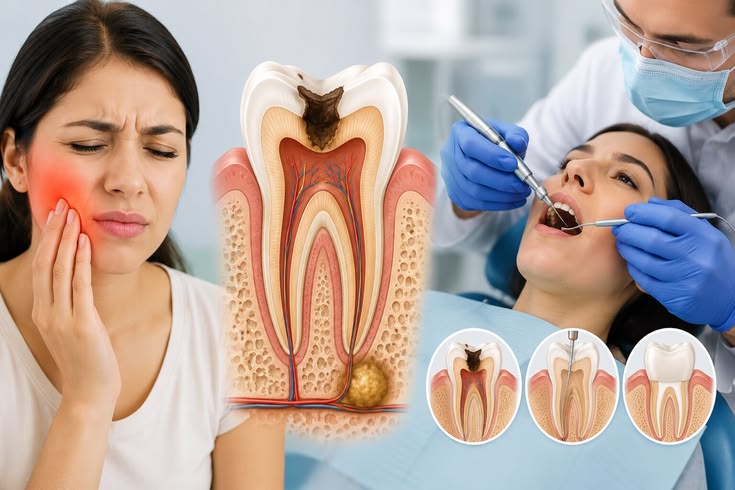
A tooth requiring root canal treatment may produce prolonged sensitivity after hot or cold drinks. The key word is prolonged. A brief response lasting a second or two can occur with ordinary sensitivity. Pain that continues after the stimulus has gone deserves closer investigation.
Spontaneous throbbing is more suspicious.
Pain that wakes someone from sleep is another pattern dentists take seriously. Patients sometimes describe needing cold water in the mouth for relief. Others cannot identify the exact tooth because the pain seems to spread through the jaw, ear or neighbouring teeth.
Biting tenderness is different again. The tooth may feel “higher” than the others. Chewing on one particular side becomes uncomfortable.
Then there are teeth that hardly hurt.
A dead pulp may remain quiet until infection progresses around the root. Signs can include gum swelling, facial swelling, a recurring gum boil, pus discharge, unpleasant taste or tenderness when pressing the gum near the root.
Tooth discolouration after an old injury is another clue. Trauma during childhood or adolescence can damage the pulp, yet symptoms may not appear until years later.
These situations require examination rather than guesswork.
Patients also make a common mistake here: repeatedly taking antibiotics whenever the tooth flares up.
Antibiotics are not a substitute for treating an infected root canal. They may be indicated when dental infection is accompanied by spreading swelling, systemic involvement or other specific clinical circumstances, but tablets cannot mechanically clean infected tissue from inside a closed root canal system.
The source still needs treatment.
Anyone searching for a Root canal specialist in Haripad because of recurring swelling should mention previous episodes, previous antibiotics, old injuries and any earlier fillings or crowns. Those details often explain more than the pain score does.
Modern Root Canal Treatment Feels Very Different From Its Reputation
Root canal treatment has inherited a reputation from dentistry that is several decades out of date.
The irony is that patients often associate the procedure with pain when the severe pain usually comes from the inflamed or infected tooth before treatment.
Modern local anaesthetics, better instruments, electronic working-length measurement, rotary or reciprocating endodontic systems, improved irrigation protocols and better imaging have changed the experience considerably.
That does not justify promising that every root canal will be completely painless.
An acutely inflamed lower molar, particularly one with severe irreversible pulpitis, can sometimes be difficult to anaesthetise fully using a routine injection alone. Supplemental anaesthetic techniques may be needed. Good dentistry recognises this instead of continuing while the patient is uncomfortable.
Proper anaesthesia is the foundation of Painless root canal treatment Haripad patients are often searching for.
Technique matters after anaesthesia too.
Modern nickel-titanium instruments can negotiate curved canals more efficiently than older stainless-steel techniques in appropriate cases. Electronic apex locators help establish working length. Dental magnification can help identify small canal openings and cracks. Digital radiography gives useful information with rapid image availability.
None of these tools replaces judgement.
A dentist can own sophisticated equipment and still underestimate a crack, miss a canal, leave inadequate tooth structure for restoration or fail to identify a periodontal problem.
There may also be soreness after treatment.
Mild tenderness while biting for a few days does not automatically indicate failure. The tissues around the root have been treated in an area that was already inflamed. Some teeth settle almost immediately. Others remain tender for several days.
Severe increasing pain, significant swelling, fever or symptoms that continue rather than gradually settling need reassessment.
Patients sometimes test a recently treated tooth aggressively because it “still feels different”. Biting repeatedly on it to check whether the discomfort has disappeared achieves very little except keeping the area irritated.
Give the tissues time.
Where Root Canal Treatment Commonly Goes Wrong
The most visible mistake happens after the root canal is completed.
The patient disappears.
Pain has stopped, so the temporary filling remains for months. The tooth is never definitively restored. Part of it eventually fractures, bacteria leak around the temporary restoration or so much structure breaks away that a tooth that was originally saveable becomes difficult to restore.
The root canal was not necessarily the failure.
The unfinished treatment plan was.
This is especially relevant for heavily filled premolars and molars. Removing decay and accessing the root canals reduces the amount of remaining tooth structure. If the cusps are thin or undermined, normal chewing forces can split them.
A crown is not automatically required for every root-treated tooth, but posterior teeth with substantial structural loss frequently need some form of cuspal coverage. The decision should depend on remaining tooth structure, tooth position, bite, crack pattern and existing restorations rather than an automatic rule.
There are failures inside the root canal system as well.
A canal may be missed. Anatomy may be unusually complex. A canal may be heavily calcified. Infection may persist in areas that cannot be predictably disinfected. A previous root filling may be short, poorly sealed or difficult to remove.
Occasionally the problem is not endodontic at all.
A vertical root fracture can imitate a failing root canal. Localised deep periodontal probing around one section of the tooth can be a useful clue. Persistent biting pain can also come from a crack extending through the root.
Retreatment is possible in selected cases. Endodontic surgery may be appropriate in others. Extraction becomes the sensible choice when the underlying structure is no longer predictable.
This is why choosing the Best dental clinic for root canal in Haripad should involve more than comparing prices or looking for promises of treatment in a single sitting.
Ask how the tooth will be restored.
Ask whether the diagnosis is certain.
Ask what happens if complex anatomy is found.
Ask about the prognosis.
Those questions tell you considerably more than the phrase “advanced root canal”.
Choosing Root Canal Care in Haripad Without Chasing Labels
Dental emergencies rarely arrive at convenient times. A painful molar on a working day, swelling before travel, a broken filling during a weekend. Distance suddenly matters.
That makes local care useful.
Choosing Root Canal Treatment in Haripad allows examination, treatment and follow-up to happen without repeated long-distance travel. Follow-up becomes particularly relevant when a root canal requires more than one visit, when a temporary restoration needs review or when the final crown or other restoration is being planned.
Local does not automatically mean suitable.
Look at the clinical process rather than the advertising.
A proper assessment should establish whether the tooth genuinely needs root canal treatment. There should be an explanation of the tooth's restorability, not merely the condition of the nerve. Appropriate imaging should be taken. Anaesthesia and isolation should be handled carefully. The final restoration should be discussed before the root canal is regarded as complete.
Patients sometimes select a clinic based entirely on the promise of a “single-sitting root canal”.
Single-visit treatment can be entirely appropriate for certain teeth and clinical situations. It is not a quality label. Some teeth benefit from treatment over more than one appointment because of active infection, drainage, difficult anatomy, retreatment requirements or other factors.
Speed is useful only when biology allows it.
The same applies to cost.
The cheapest initial quotation can become expensive when the figure excludes the core build-up, crown, imaging, retreatment of a previous root canal or management of complications. Patients should know what the proposed fee covers before treatment begins.
For someone comparing options for Root Canal Treatment in Haripad continuity of care can be worth more than a small difference in initial price. A dentist who can review the tooth, complete the restoration and monitor it later has a practical advantage.
The objective is not simply to finish the root canal.
The objective is to keep the tooth functioning.
Experiences
Expert Dentist
Dentist Services
Dentist Equipments
FAQ
Why is root canal treatment important for saving natural teeth?
When infection or irreversible inflammation has reached the pulp, simply placing a filling over the cavity usually cannot solve the problem. Root canal treatment removes diseased tissue from inside the tooth and disinfects and seals the canal system while preserving the external tooth structure.
When the tooth is structurally restorable and has adequate periodontal support, this can allow it to remain functional for years. The alternative may eventually be extraction followed by a gap, bridge, implant or another replacement option.
A natural tooth with a reasonable prognosis is usually worth preserving. A structurally hopeless tooth is different.
What are the warning signs that you may need a root canal?
Persistent hot or cold sensitivity, spontaneous throbbing, night pain, pain when biting, swelling, a recurring gum boil, pus discharge and darkening of a previously injured tooth are common warning signs.
Absence of pain does not rule out pulp death or infection.
Diagnosis needs clinical testing and appropriate imaging.
How does modern technology make root canal treatment painless?
The biggest factor is effective local anaesthesia. Modern anaesthetic techniques can make treatment comfortable for most patients. Rotary or reciprocating endodontic instruments, electronic apex locators, digital radiography, magnification and improved irrigation methods can also make treatment more controlled and efficient.
An acutely inflamed tooth can occasionally be difficult to numb completely. Supplemental anaesthetic techniques may be required.
Why choose a local dentist for root canal treatment in Haripad?
Convenience matters because root canal care may involve diagnosis, treatment, restoration and follow-up rather than a single appointment.
Having the clinic nearby makes review easier if the tooth remains tender, if a temporary restoration becomes damaged or when the final crown or restoration needs adjustment.
Clinical quality should still come before distance.
What is root canal treatment?
It is a procedure used to treat inflamed, infected or dead pulp tissue inside a tooth. The dentist accesses the pulp chamber, cleans and disinfects the root canals and seals them to reduce the possibility of reinfection.
The natural tooth remains in the mouth.
Your Healthier Smile Awaits - Book Now!
Your Healthier Smile Awaits - Book Now!
The goal of our clinic is to provide the best dentistry to our patients.


Copyright © 2026. Sree Lakshmi Multi Speciality Dental Care.All Right Reserved.
Copyright © 2026.
Sree Lakshmi Multi Speciality Dental Care.
All Right Reserved.